Elephants in Phuket live in two different formats: camps where you ride elephants, and sanctuaries where you feed and watch them. Both operate legally and both are sold as excursions. The difference isn't the sign on the gate but what happens to the animal before the tourists arrive. Below is exactly what, and how to tell one from the other.
Why riding harms an elephant
It comes down to anatomy. An elephant's spine isn't built like a horse's: the spinal processes point upwards and aren't designed to carry a load from above. The wooden saddle, the howdah, weighs tens of kilograms on its own, and then come two adults and the mahout. Working constantly under that load causes sores, fistulas and deformation of the back.
The second part is the training. For an elephant to accept a saddle and obey the hook, it is put through a breaking process known in Thailand as phajaan. A young animal is confined for several days in a tight frame and conditioned through pain. This isn't a conservationists' myth but a documented practice that Thai vets write about too.
We're not out to shame anyone: most tourists find this out only after they've bought a ticket. The point of this article is to have the information before you buy.
What a sanctuary is and how it differs from a camp
The word sanctuary isn't protected by law in any way — anyone can write it on their gate. The signs of a genuine project are specific.
- Nobody rides the elephants at all, and there are no saddles on the grounds
- No ankus hook is used; the mahout works with voice and food
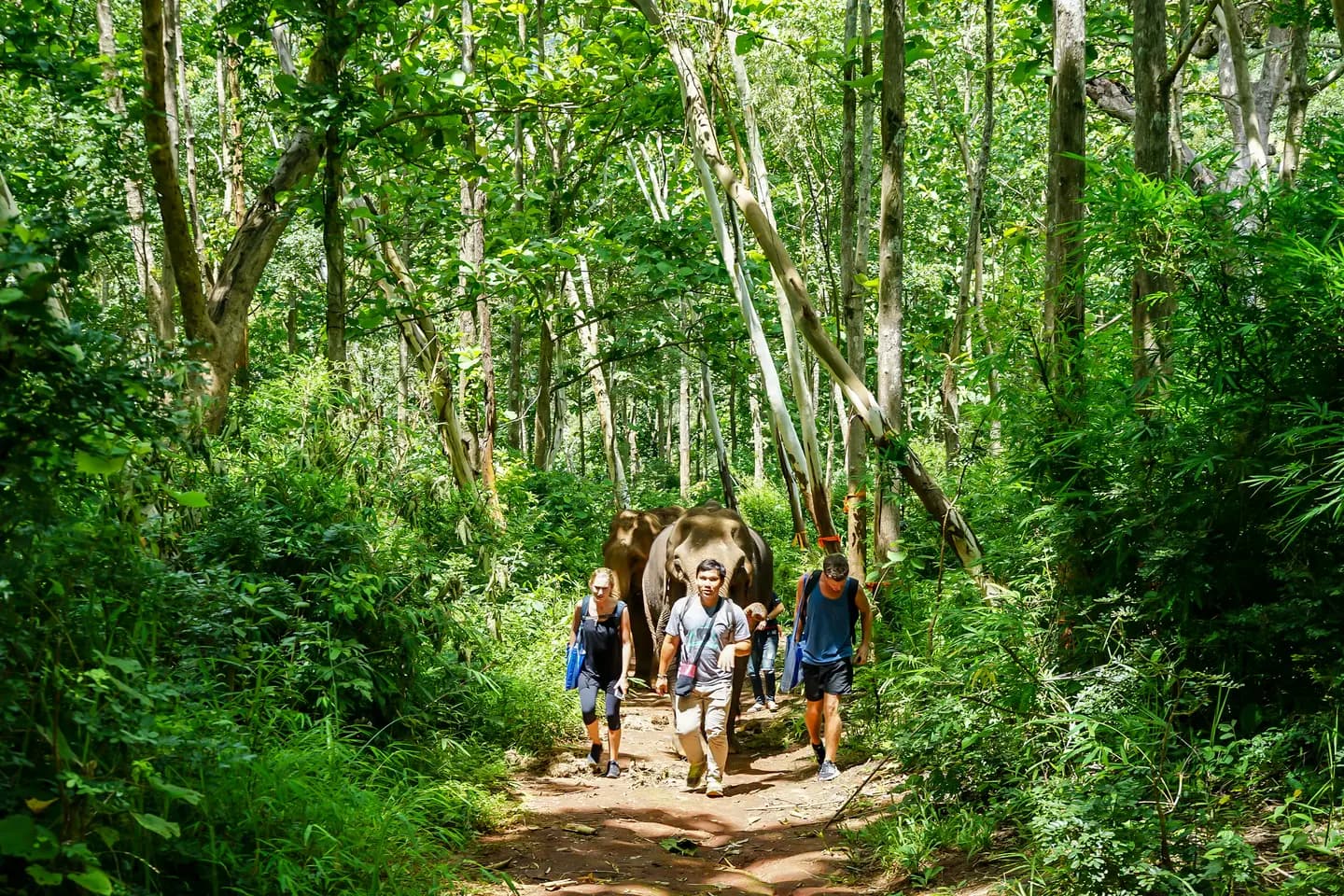
- Visitors feed and watch, but don't sit on the elephants or take part in tricks
- The elephants spend most of the day free, not chained up waiting for the next group
- Group sizes are limited and visits run in sessions
- The park openly publishes where its elephants came from and what happened to them before
If even half of these aren't met, it's a camp that has changed its name.
Bathing with elephants: this one is more complicated
Bathing looks more harmless than riding, and some parks present it as an ethical alternative. But there's a catch here too.
When an elephant is bathed in a pool ten times a day with a new group each time, it stops being bathing and becomes shift work. The animal has to stand still and put up with contact, and to make it stand still there's still a mahout with a hook nearby.
Some projects have already dropped bathing with tourists, keeping only the chance to watch the elephants bathe on their own. That's closer to what an elephant does in the wild.
How to check a park before you buy
Five questions worth asking the seller or checking on the website.
- Is there riding on the grounds, even as a separate program? If yes, that settles it
- How many elephants are there, and how many people are in a group at once?
- Can you touch and wash the elephant, or is the program limited to feeding and watching?
- Where did the elephants come from: logging, a circus, another camp?
- Is there a vet on site, and how often?
The photos on the website say a lot too. If the gallery shows people on an elephant's back and the text says sanctuary, something doesn't add up.
What it costs and how long it takes
Programs usually last two to three hours with a hotel transfer. With us, elephant parks are part of combined trips: "KHAO LAK SAFARI: jungle, elephants and bamboo rafts" costs 1,650 ฿ and takes 8 hours, "RAFTING + ELEPHANT SPA" is 1,550 ฿ for 8 hours. The child rate is lower than the adult one; exact prices and what's included are on each tour's page.
Morning sessions are more comfortable: in the middle of the day the open grounds are hot for both elephants and people.
What to bring
- Clothes you don't mind getting dirty
- A spare T-shirt
- Closed shoes — the ground is usually dirt
- Water and a hat
- Insect repellent
Frequently asked questions
Where can I see elephants in Phuket?
Several parks and sanctuaries operate on the island and on the nearby mainland, mostly around Chalong, Patong and Phuket Town, as well as in Phang Nga province. We take guests to parks with no riding — the specific venues are listed on each excursion's page.
Can I ride an elephant in Phuket?
Technically yes — there are such camps on the island. We don't sell these programs: riding under a saddle harms the animal's spine, and preparing an elephant for it involves pain.
How does a sanctuary differ from a camp?
A sanctuary has no riding and no hook, the elephants aren't chained up waiting for groups, and visits run in sessions with limited numbers. The word sanctuary guarantees nothing on its own — look at the program.
Can I bathe with elephants?
Some parks allow it. Bear in mind that with a steady stream of groups it turns into non-stop work for the animal. Watching elephants bathe on their own is closer to natural behaviour.
Is the program suitable for children?
Yes, feeding and watching are usually designed for families. Check the minimum age with the specific park.
How long does the trip take?
Two to three hours for the program plus the drive from your hotel. With the transfer it's half a day, and on combined trips it's a full day.
Elephant excursions with no riding
We take guests to parks with no riding. Hotel transfer, a Russian-speaking escort, feeding and watching.
- KHAO LAK SAFARI: jungle, elephants and bamboo rafts — 1,650 ฿, 8 hours
- RAFTING + ELEPHANT SPA — 1,550 ฿, 8 hours
- AVATAR WORLD: jungle, elephants, quad bikes and hot springs — 2,950 ฿, 11 hours
- ELEPHANT BEACH + SAMET NANGSHE + MANTRA SPA — 3,350 ฿, 9 hours